
By Trace Mdamu
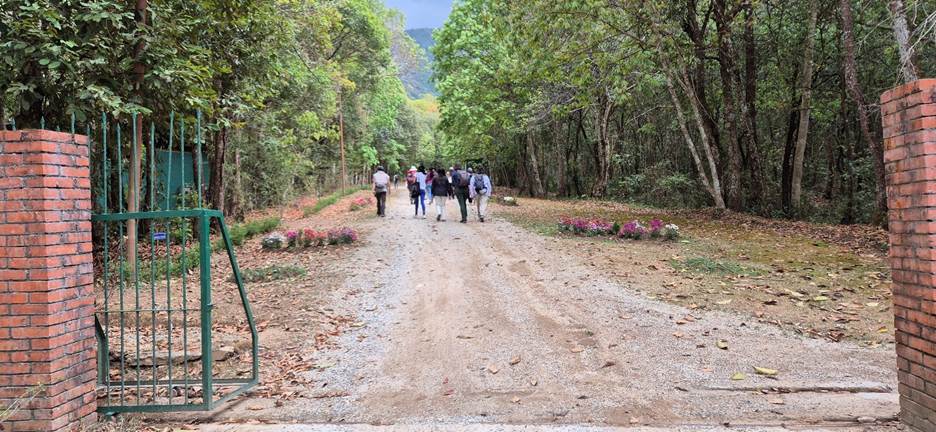
Going there: Author’s own photo, ICIMOD Knowledge Park, Kathmandu. 11/4/2025.
THE PAST
A year ago if you asked me about fieldwork, I probably would have had no impression of it, having never been there, and although aware of the privilege and unprivileged aspects of fieldwork, I was unfamiliar with going there (Philips and Johns, 2012). Nevertheless, I had my first chance of fieldwork as part of a group trip to Nepal from 9th to 22nd April 2025.
After being back for some months now, I realised how extremely privileged I was to be in Nepal. After considering all my learning and unlearning I did on this field trip, questions on what to give back and how to give back have been echoing on my mind (Staddon, 2014). Our amazing partners, SIAS who worked with us tirelessly for two weeks to ensure that everything on the field went smoothly, truly embodied access in the form of love. It was all about the emotions, such as care and kindness, which I was able to experience in the field beyond ticking a checklist (Guasco, 2022). On thinking about the ethics of giving back, this blog was something that I was particularly keen on as through the idea of reciprocity. As such, this blog presents my reflection on this field trip exploring my experience of fieldwork through an emotion lens.
ETHICS AND POSITIONALLY
Before engaging in the fieldwork there was a constant question that kept playing on mind. This question was “So what kind of student are you”? (Staddon, 2014, p. 250). Throughout the flight to Kathmandu, I often found myself thinking and reflecting on my meaningful engagement in fieldwork. I was aware of the existing partnership with SIAS and our University of Edinburgh. Similarly, I was conscious of various speakers and institutions which had invested their resources to make our fieldwork experience worthwhile. Therefore, as a student I often found myself questioning how to make this trip worthwhile for everyone involved. This question was the beginning of my reflections on the ethics of being in the field.
My reflection on positionally, as an Environment and Development student in Nepal, were that the interactions whether academic or non-academic were guided by humility. Thinking about the learning and unlearning I did in Nepal, the idea of intellectual humility is embodied in my mind, through the practice of openness and humility in learning (Koch, 2020). So, from the outset, I had an open mind at all times to other ways of knowledge rather than relying on my assumptions and experience. We met a variety of professionals working on water, gender, forestry, amongst other issues that we engaged with. Whilst, I am aware of the diversity of our backgrounds and how we view and reflect on the Environment and Development landscape, in my opinion the diversity of our field trip is what made the field a successful learning environment.
IN THE FIELD
The group research process experience as part of the field trip learning enabled me to observe first-hand how complex the Environment and Development linkages are. As a researcher in the field, it was interesting to see the real-world complexity of Environment and Development issues. For instance, through human and wildlife relations: whilst preserving the forest leads to environmental sustainability, people are consistently troubled by wildlife destroying their crops and livelihoods. Researching through the transect walk and the focus group discussion (among other methods used first hand) made me increasingly aware of this multifaceted relationship. If asked for an outstanding moment in my Masters journey then the Nepal Field trip is definitely one where from a group and an individual perspective, I experienced the most.
Thus, this field trip enriched my learning away from classroom activities. I learnt about the ethics of engaging in field research. As argued by Sultana (2015, p .374) I appreciate the need for “greater attention to reflexivity, positionality and power relations in the field”. It helps me to consider whether the ‘expert’ label is attached to my identity. I think about what to give to the communities that give their time to see me, to contemplate consent in participation and to consider my approach to adaptability in view of existing social unnamed norms like gender imbalance and fair participation. I was privileged to explore all these aspects in the field at the Chhapeli Community Forest User Group in Bandipur through our group research of human wildlife relations. As an outsider I felt grateful for the warm reception and care given to us by the community.
Going forward as I reflect the one thing that I enjoyed the most during this field trip, naming it a ‘rose’, as one of my instructors (Clare Barnes) put it, my thoughts turn to kindness. As a group that travelled together, the kindness shown by staff, amongst peers and our partners SIAS as a ‘token of love’ is a timely reminder that the field is as much as a learning environment as it is about working collaboratively.
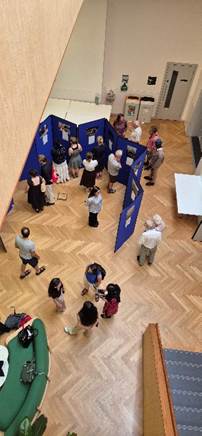
Collaborative work through our Nepal Exhibition back in Edinburgh, showing photos and a film on the trip: Author, 13/08/2025.
REFERENCES
Guasco, A. (2022) ‘On an ethic of not going there’, The Geographical Journal, 188(3), pp. 468–475. Available at: https://doi.org/10.1111/geoj.12462
Koch, N. (2020) ‘Deep Listening: Practicing Intellectual Humility in Geographic Fieldwork’, Geographical Review, 110(1–2), pp. 52–64. Available at: https://doi.org/10.1111/gere.12334
Phillips, R. and Johns, J., (2012) Fieldwork for human geography.
Staddon, S., (2014) ‘So what kind of student are you?’ The ethics of ‘giving back’ to research participants: Experiences from fieldwork in the community forests of Nepal. In Fieldwork in the Global South (pp. 249-261). Routledge.
Sultana, F. (2015) ‘Reflexivity, Positionality and Participatory Ethics: Negotiating Fieldwork Dilemmas in International Research’, ACME: An International Journal for Critical Geographies, pp. 374-385 Pages. Available at: https://doi.org/10.14288/ACME.V6I3.786
“Views expressed here are personal and not associated with any affiliated organisations”