
Published Online: November,2025
Authors: Hemant Ojha, Basant Maheshwari, Jeff Camkin, Basundhara Bhattarai, Purnima Banjade, Priyanka Gurung, Karen Delfau, Vishal Narain, Will Allen, Sarah Ransom, Vishal Singh, Roshan Rathod, Ngamindra Dahal, Susana Neto, Monika Giri, Shive Prakash Rai, Icyimpaye Adeline
Available at: https://doi.org/10.1002/wwp2.70041
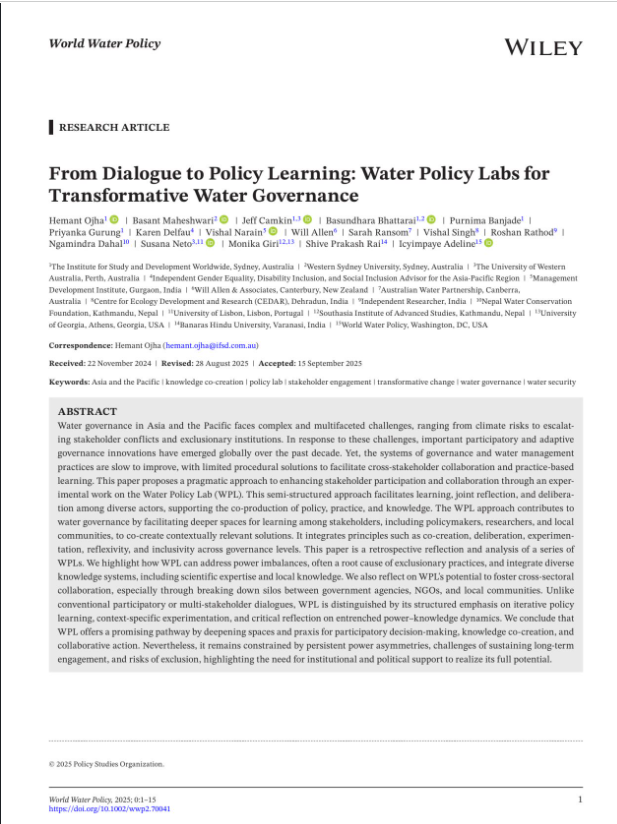
Abstract: Water governance in Asia and the Pacific faces complex and multifaceted challenges, ranging from climate risks to escalating stakeholder conflicts and exclusionary institutions. In response to these challenges, important participatory and adaptive governance innovations have emerged globally over the past decade. Yet, the systems of governance and water management practices are slow to improve, with limited procedural solutions to facilitate cross-stakeholder collaboration and practice-based learning. This paper proposes a pragmatic approach to enhancing stakeholder participation and collaboration through an experimental work on the Water Policy Lab (WPL). This semi-structured approach facilitates learning, joint reflection, and deliberation among diverse actors, supporting the co-production of policy, practice, and knowledge. The WPL approach contributes to water governance by facilitating deeper spaces for learning among stakeholders, including policymakers, researchers, and local communities, to co-create contextually relevant solutions. It integrates principles such as co-creation, deliberation, experimentation, reflexivity, and inclusivity across governance levels. This paper is a retrospective reflection and analysis of a series of WPLs. We highlight how WPL can address power imbalances, often a root cause of exclusionary practices, and integrate diverse knowledge systems, including scientific expertise and local knowledge. We also reflect on WPL’s potential to foster cross-sectoral collaboration, especially through breaking down silos between government agencies, NGOs, and local communities. Unlike conventional participatory or multi-stakeholder dialogues, WPL is distinguished by its structured emphasis on iterative policy learning, context-specific experimentation, and critical reflection on entrenched power–knowledge dynamics. We conclude that WPL offers a promising pathway by deepening spaces and praxis for participatory decision-making, knowledge co-creation, and collaborative action. Nevertheless, it remains constrained by persistent power asymmetries, challenges of sustaining long-term engagement, and risks of exclusion, highlighting the need for institutional and political support to realize its full potential.