
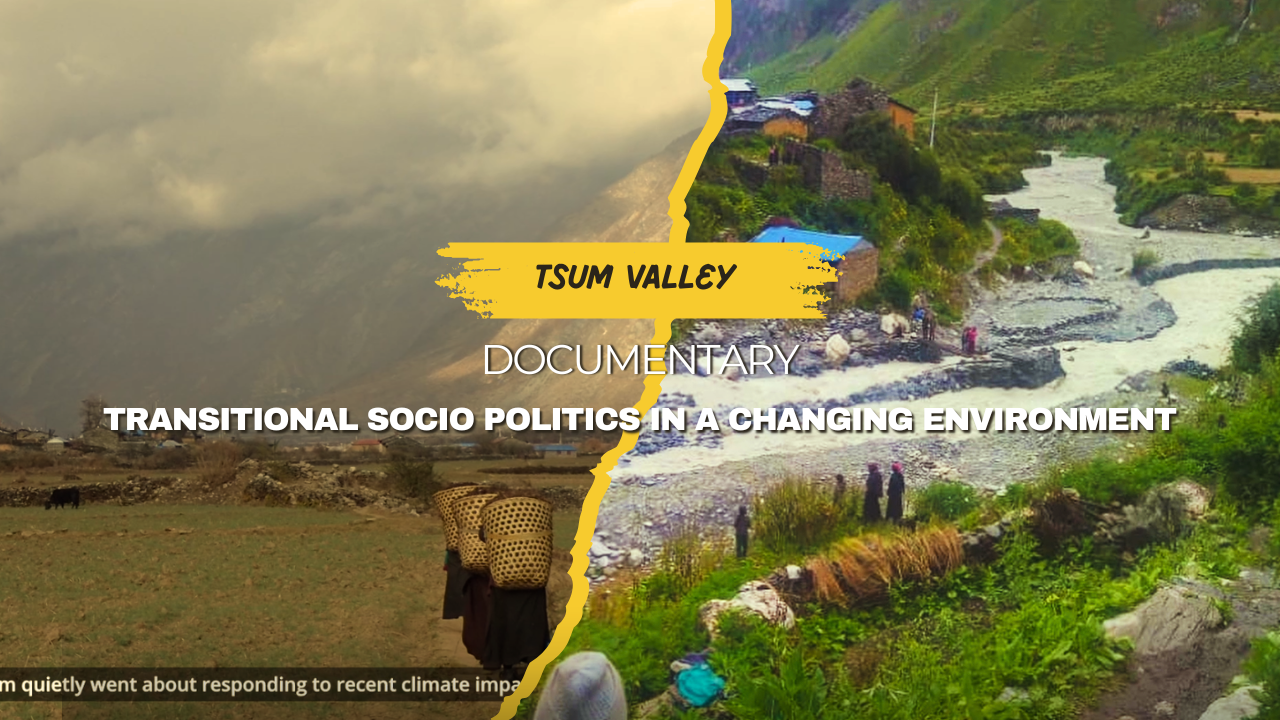
In this video, Tsum valley, located in Gorkha District was studied to understand how the dynamics of socio-political transitions in a changing environment are affecting resource management. After the devastating Earthquake 2015 in Nepal, there has been disputes on who should have control over resources like forests, pastures, valuable medicinal herbs like Yartsagunbu. The new government policies have made the new local authorities, religious institutions and conservation agencies to clash over natural resource management, leading to conflicts and uncertainty.
Traditionally, Tsum valley has been deeply connected to the region’s religious leaders or lamas for land governance, with frequent practices of Shargya, serving as a foundation of conservation. However, with new transitioning policy, governance and environment, the existing traditional systems are being challenged. The video highlights the struggle between the old and new governance systems and raises crucial questions about how the current modern development focused approach can maintain a balance between the state, society and the environment.
This video is prepared via a project “Conflict, Violence and Environmental Change: Investigating resource governance and legitimacy in transitional societies” (COVEC) supported by Swedish Research Council Development grant (#2015-03323). The study was conducted in two countries: Nepal and Kenya, in collaboration with the Swedish University of Agricultural Sciences (SLU), Sweden, Southasia Institute of Advanced Studies (SIAS), Nepal, Norwegian University of Life Sciences, NORAGRIC-Norway, Jaramogi Oginga Odinga University of Science and Technology (JOOUST), Kenya and the University of New South Wales, Australia.
We are grateful to the funding support from University of Edinburgh through the project LLNOB [Learning to ‘Leave No One Behind’: Equitable and sustainable livelihoods in natural resource governance in Nepal and India – developing an international research cluster] for the making of the video.