
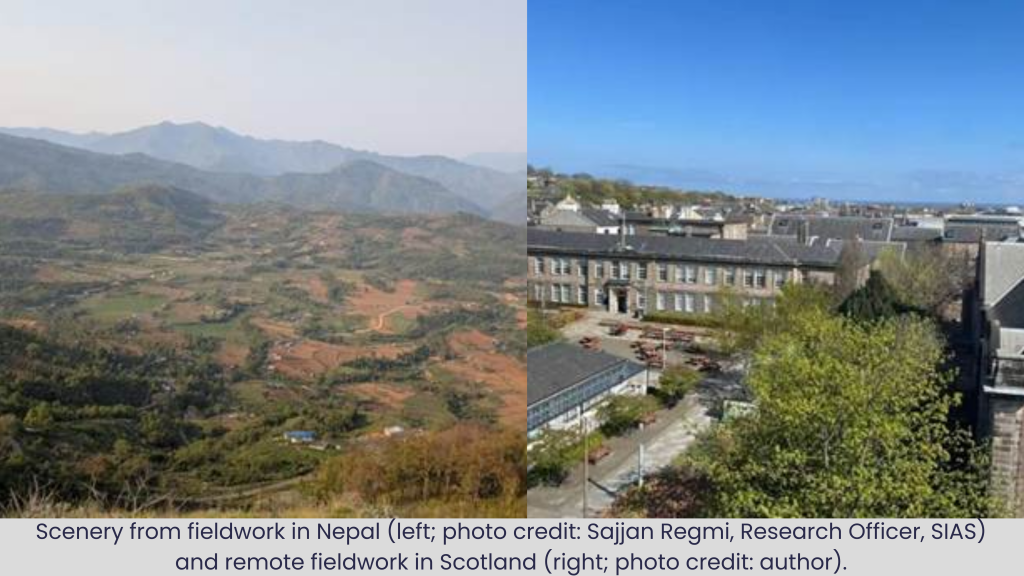
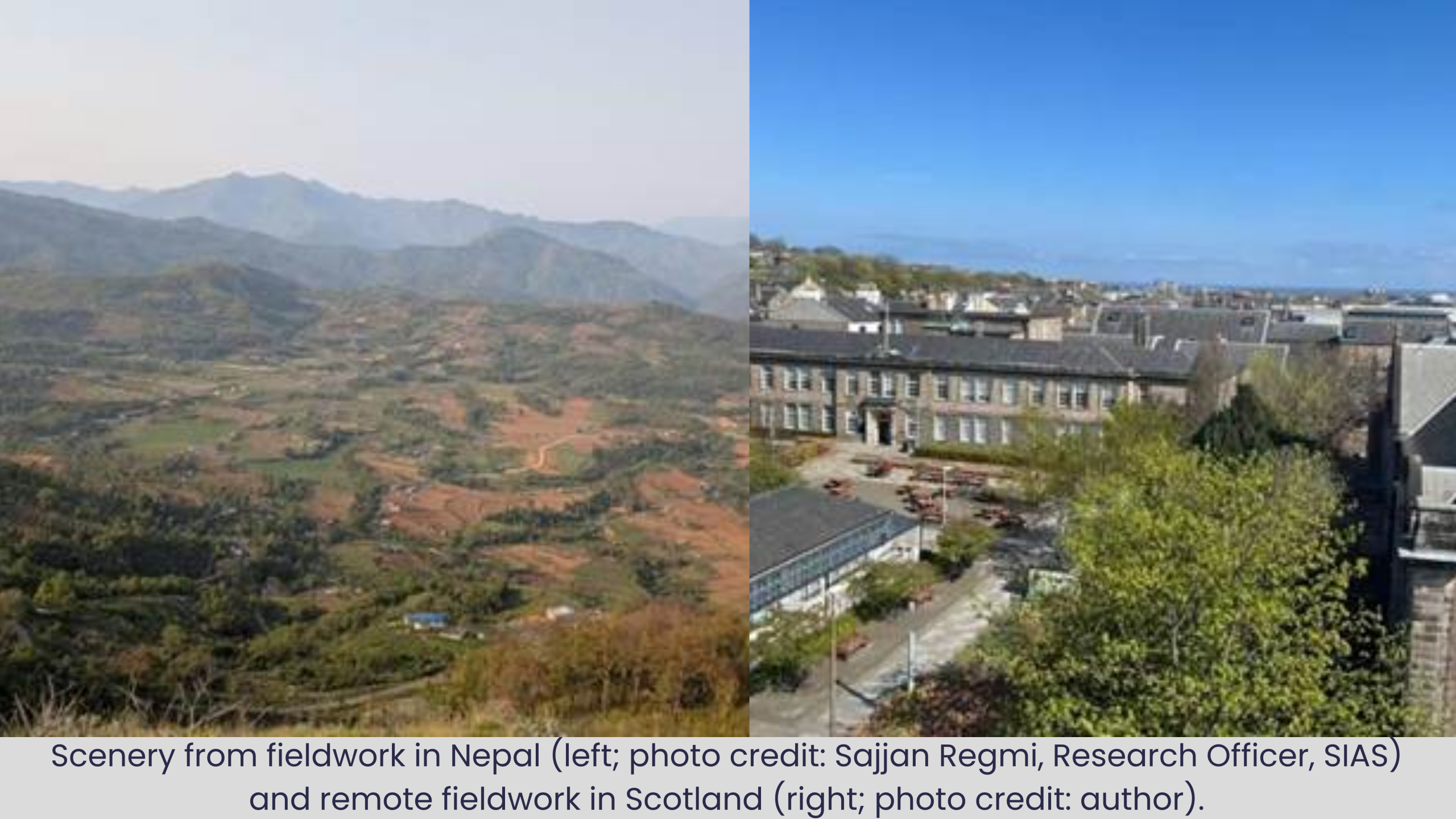
By Yuefei Wu, University of Edinburgh
When Fieldwork Begins in Absence
When I heard I would be unable to undertake fieldwork in Nepal, I felt disheartened and began to wonder: if I could not physically enter local communities and observe the social environment, would I still be able to truly understand the environment and development issues facing the Global South? I also worried whether the methods of maintaining curiosity and active listening that I had learnt in the classroom could be fully applied in the absence of field experience. As Howkins (2010) pointed out, ‘going there’ has long been regarded as a crucial means for geographers and researchers to acquire data, authority and expertise. Consequently, I initially believed that not going to Nepal made my learning incomplete and limited my opportunity to gain first-hand understanding.
However, Guasco’s (2022) perspective has led me to rethink ‘absence’. She argues that in both ‘field’ and ‘remote’ research, researchers are never fully neutral, but are shaped by their identities, resources, power relations and limitations. Thus, presence does not guarantee authenticity or legitimacy, nor does absence make fieldwork less real or valuable.
Seeing the Gap Between Concepts and Lived Experience
The structure of this section is based on Gibbs’ reflective cycle.
From 13 to 23 April, we took part in the Southasia Institute of Advanced Studies (SIAS) online field course through presentation slides. However, on 17 April, when Dilli P. Poudel, Dil B. Khatri, Sushant Acharya and Govinda P. Paudel discussed changes in community forestry, I struggled to concentrate and did not fully grasp their presentations. Although I had expected the topic to be familiar and easy to follow, I found it difficult to understand the experiences of Community Forest User Groups (CFUGs), began to lose focus, and felt ashamed of my lack of concentration.
On the positive side, even without travelling to Nepal, I was still able to engage with local community forestry case studies through SIAS. At the same time, however, the shortcomings were evident: I did not manage my negative emotional state in a timely way, which led to reduced concentration and an incomplete understanding. Furthermore, the online format limited my ability to grasp the field experience through physical feelings, spatial context, sounds and interpersonal interaction.
Upon further reflection, I realised that the reason for my mind wandering was not simply the online course itself, but rather the gap between my own life experiences and those of the CFUGs. I am not a member of a CFUG, nor do I depend on community forests for my livelihood; I was merely sitting in a classroom at the University of Edinburgh, attempting to understand their experiences through a screen and presentation slides. Consequently, when the lecture referred to ‘the forest as a source of subsistence livelihood’ and ‘the expanding forest and increasing wildlife’, I treated these as academic concepts rather than real-life challenges faced by local people. Rose’s (1997) research also helped me to understand this. She pointed out that researchers cannot fully comprehend or control the power dynamics within a study; our understanding of others’ experiences is always limited. Reflecting on this online fieldwork, I realised that, given these inherent limitations, letting my mind wander further undermined my understanding of the CFUGs’ experiences.
This has made me realise that when studying environments and development issues, I cannot treat lecture content as abstract concepts. My location, learning environment and state of mind all influence how I interpret others’ local experiences.
In future online fieldwork, I will use pen and paper to record key facts and my immediate reactions, to help me stay focused. When encountering content that is difficult to understand or less engaging, I will remind myself that behind the concepts lie real people and their lives. I will also acknowledge the limitations of my understanding and avoid treating remote information as a complete representation of local experience.
Fieldwork Is Not Always in the Field
My group’s research topic was community forestry. To be honest, before our group research began, I had always believed that on-site fieldwork was the most effective way to conduct research. This is because, in person, we can understand one another through body language, eye contact and the physical atmosphere of the setting; it also allows each interviewee to come across as more concrete, authentic and ‘colourful’.
However, when our group began conducting interviews and collecting data with local people online, the limitations of remote fieldwork soon became apparent. The internet connection was consistently unreliable; the problem was not that they could not hear us clearly, but that we often could not make out their replies. The intermittent audio made communication difficult, and I gradually lost my patience and interest, even finding myself wishing the interviews would end quickly.
But I gradually came to realise that this struggle itself is part of learning through fieldwork. In the real world, fieldwork does not always take place under ideal conditions, nor can researchers always gain unhindered access to the field. As Laborde et al. (2018) point out, the need to adapt research plans to local conditions is not a new phenomenon; these conditions may include political unrest, environmental disasters or other socio-environmental disruptions. This made me realise that the difficulties encountered in online fieldwork were not a failure of the method itself, but rather part of the process of reorganising fieldwork in accordance with real-world conditions. Therefore, while online fieldwork cannot fully replicate in-person fieldwork, it still offers a practical means of connection.
More importantly, this experience has made me realise that research is never about choosing the environment that suits us best or is most comfortable. Our task is not to wait for ideal conditions to arise, but to approach different research environments with humility, acceptance and adaptability. The difficulties encountered in online communication certainly tested my patience, but they also strengthened my resilience to continue learning and adapting under uncertain conditions. It reminded me that true listening does not happen automatically, but requires effort, reflection and self-adjustment.
It was during this very moment that I began to understand more deeply the significance of my major, Environment and Development. It is not merely about studying environmental change or development challenges, but about understanding how people, livelihoods, places and power relations are interconnected. At the same time, it requires us to maintain humility, adaptability and a sensitive capacity for listening when confronted with diverse lived experiences.
Keeping the Lens Open
In this sense, for me, fieldwork is not merely about arriving at a specific location, but rather a learning process involving constant interaction with local knowledge, community experiences and one’s own position. Even whilst in Scotland, I need to remain open-minded and reflective, acknowledge the incompleteness of my understanding, and continually adjust my approach through active listening.
References
Guasco, A. (2022) ‘On an ethic of not going there’, The Geographical Journal, 188(3), pp. 468–475.
Howkins, A. (2010) ‘Have you been there? Some thoughts on (not) visiting Antarctica’, Environmental History, 15(3), pp. 514–519.
Laborde, S., Phang, S.C., Ahmadou, M., et al. (2018) ‘Co-producing research in the “Red Zone”: adaptation to fieldwork constraints with a transdisciplinary approach’, The Geographical Journal, 184(4). doi: 10.1111/geoj.12264.
Rose, G. (1997) ‘Situating knowledges: Positionality, reflexivities and other tactics’, Progress in Human Geography, 21(3), pp. 305–320.
University of Edinburgh (n.d.) Gibbs’ Reflective Cycle. Available at: https://reflection.ed.ac.uk/reflectors-toolkit/reflecting-on-experience/gibbs-reflective-cycle.
“Views expressed here are personal and not associated with any affiliated organisations”