
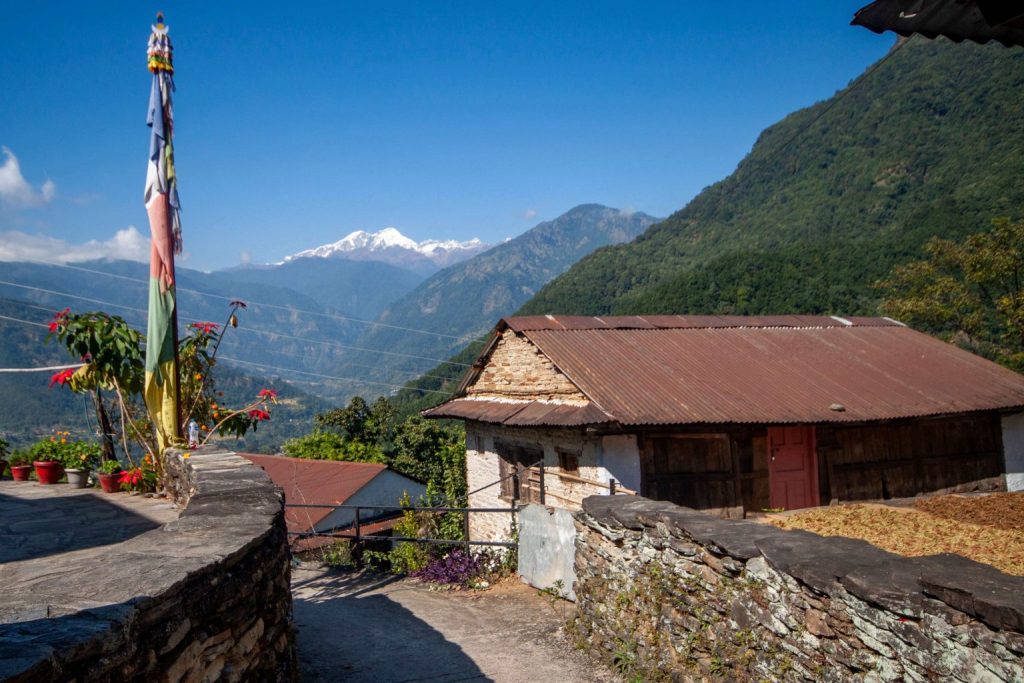
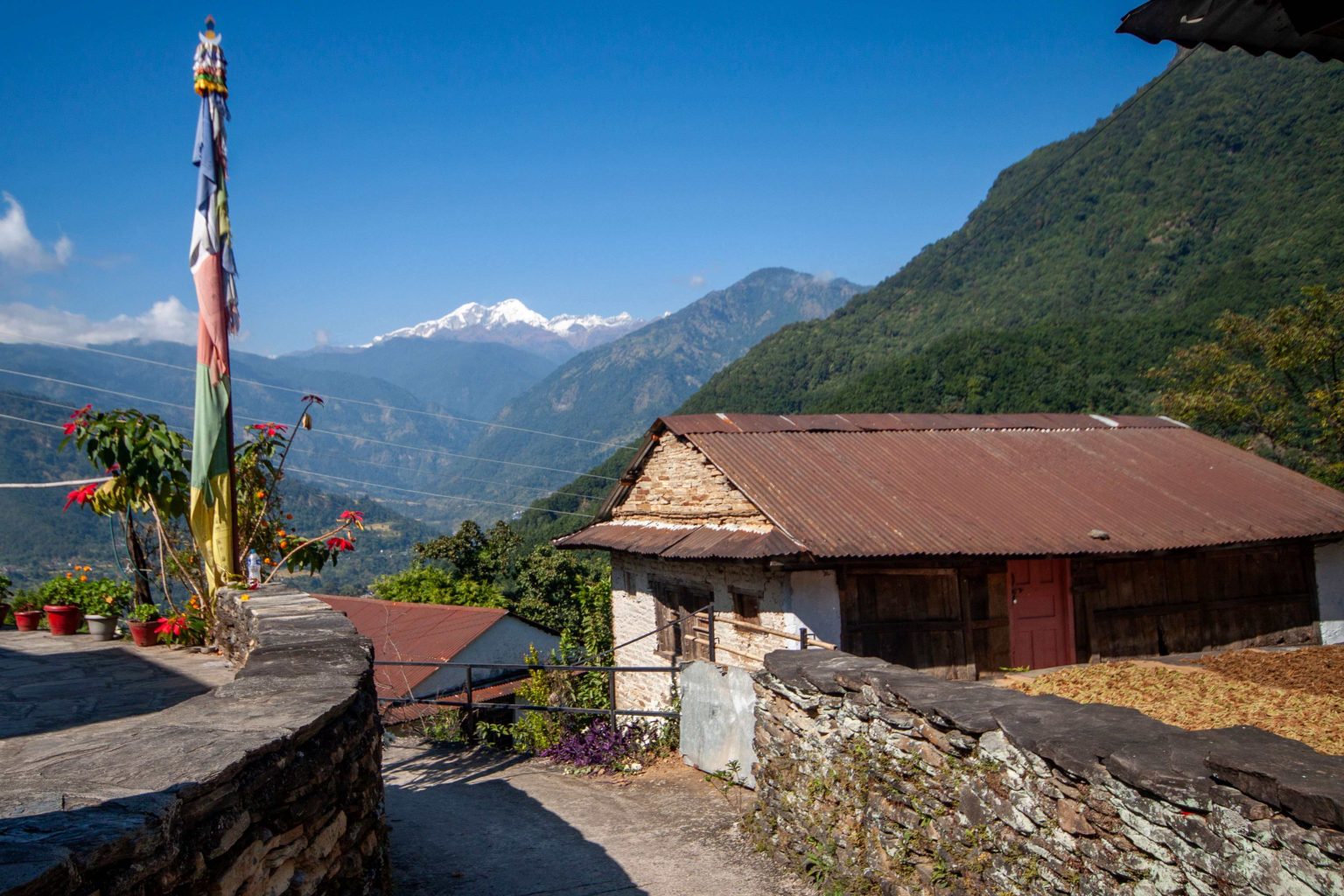
Sustained engagement marked by repeated visits, shared daily life, and cultural attentiveness allows researchers to move away from extractive practices and develop a nuanced, ethical relationship with local communities.
Long Essay | Gyanu Maskey • Kunja Shrestha • Sanjaya Khatri • Andrea Joslyn Nightingale • Dil Khatri | 26 October 2026
‘You have been coming for many years asking us questions, and we answer you. When are you going to come back here and open up an office [development NGO] and give our sons jobs?’
The woman confronting us (Andrea) glared in that way I remembered so well from sitting around the cook fire in the evenings, 20 years earlier, when she was intent on bending everyone to her will. It was a fair question, and I knew it, but I still fumbled for an answer.
‘I know you want me to do that, but that has not been my path. I have taken what you told me and presented it in Kathmandu, and even in Europe and the USA to the big offices. They have changed how they do their work as a result. The programme you got from the Park is part of those changes. I know this might not be what you want from me, but this has been my way.’
‘No, that is good, keep doing what you are doing. That is also important work.’
These kinds of moral and ethical questions that arise in ‘extractive’ research within environmental social sciences have placed questions of positionality, reflexivity, and ethical engagement central to ethnographic and participatory work with rural communities. Is influencing (in this case) development practice at larger scales adequate compensation to local people?
Researchers are often confronted with this moral dilemma regarding how to appropriately and adequately reciprocate with participants for their time, effort, and knowledge. The recurring questions—How do we engage deeply when we’re coming for a few days or a week? How do we give back in the presence of our own discomfort, and limitations of academic research?—are not merely logistical, but deeply ethical as well.
In Nepal, ethical dilemmas around extractive research are further complicated by a long history of development practice and externally driven (extractive) research, which has shaped participation as an exchange, often tied to material benefits. As a result, research participants may reasonably expect tangible returns in the form of new projects or development outcomes, or like Andrea’s participant, jobs for their sons, an expectation that academic research projects are usually unable to fulfil. While research contributions typically lie in identifying contextual issues, generating evidence and informing higher level policy processes, such outcomes rarely translate to immediate or visible benefits for communities. This disjuncture evokes some form of guilt or discomfort among researchers, like it did for Andrea, and as documented in wider debates on research ethics and reciprocity.
In this reflective piece, we reflect on our experiences with socially engaged research centred on migration, climate change, and rural livelihoods in western Nepal, particularly in Khasur, Lamjung. Taking lessons from ethnography, we go beyond interviews to present two cases to respond to our ethical dilemmas.
Engaging in everyday life and festivities
While walking down from Khasur to the nearby Deujanthok, both in Lamjung, we walked past empty houses. As we cut across the step farms, we came across an elderly couple and their daughter-in-law harvesting millet. We joined them, helping with the harvest and carrying the sacks home. Over tea, local drinks, and snacks, a simple act of helping turned into a warm and lively exchange.
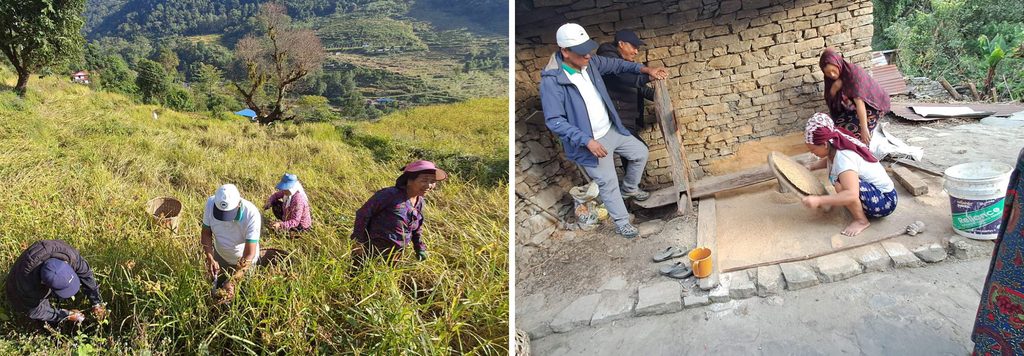
Harvesting millet in Deujanthok (left); threshing rice grains in dhiki, a traditional thresher (right).
While our research had little to do with agriculture outside of broad concerns over how climate change might affect harvests and thus fuel migration, it was an excellent opportunity for us to reflect on our observations of aspects of ongoing rural life in the village. We learnt that the couple’s two sons were abroad, with daughters-in-law staying in Kathmandu to educate their children and visiting the village to participate in farming, festivals, and family activities. Their story provided insights into how migration and education are reshaping rural life while maintaining strong ties to villages. Deujanthok’s good road connection and proximity to Besisahar, the district capital, encouraged people to maintain their rural connections rather than fully out-migrate.
In another instance, while returning from Khasur to Besisahar, we chose to hike downhill through Lete, another village, where most of Khasur people had their cultivated lands. We stopped by a group of men who were busy threshing paddy harvests. They were happy for us to join in.
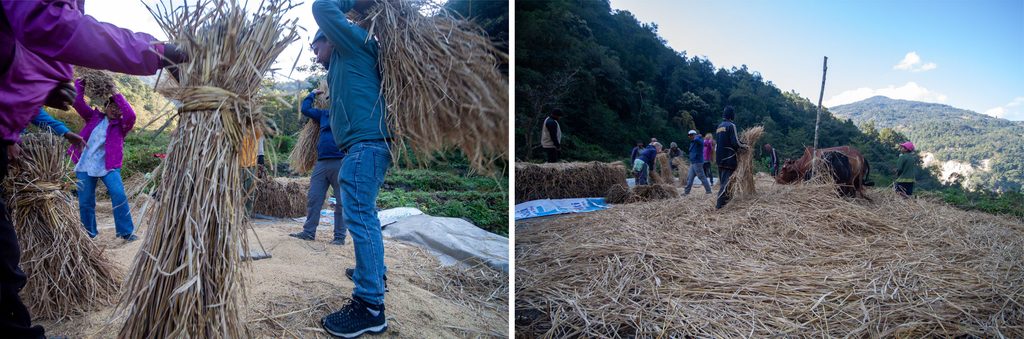
Threshing rice grains in Khasur.
Later, reflecting on our conversations, we found important insights about how migration has shaped the lives of Dalit farmers in Khasur. While one man, after 19 years in the Gulf, supported both children’s migration abroad, he now faced the dilemma of migrating again due to his wife’s illness and elderly parents remaining in the village. Another young man viewed migration as necessary due to limited employment and educational opportunities in Nepal, while continuing to support his parents and farming activities in the village.
While anthropologists have long advocated for engaging in everyday life, and particularly in rituals, it is unusual for researchers who come for shorter visits to see these events as important moments of fieldwork. When our field visit coincided with Lhosar, we chose to follow the village’s rhythm. Wearing traditional Gurung attire, joining dances and processions, sharing meals, and engaging informally helped deepen our relationships. The villagers warmly welcomed us and blessed us as members of their community.
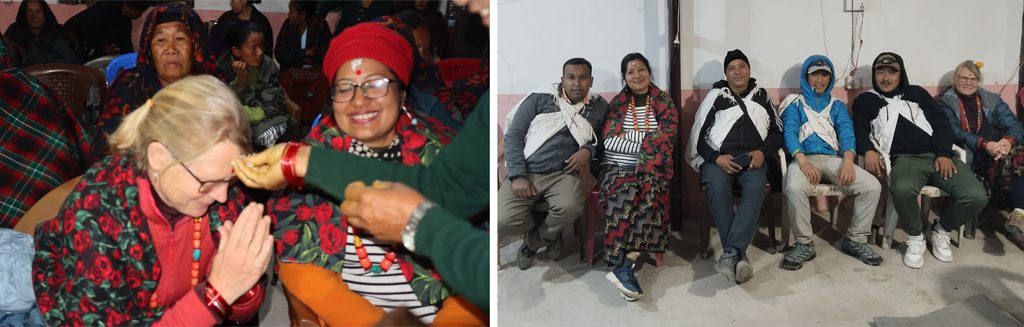
Lhosar celebrations at Khasur
Informal interactions during the festival revealed the social impacts of youth migration, from women urging unmarried men from our group to settle in the village to elders hoping for their sons’ return. Compared to our earlier visits, Khasur did not feel empty. Elders weren’t the only ones in the village, and the houses were unlocked. Similar to Lhosar, other ritualistic traditions of argu and putpute, respectively, the death and birth ritual celebrations among Gurungs also carried communal significance, bringing everyone together from near and afar. This gave us a completely different experience. Festivals revitalised the village, revealing migrants’ continued attachment to place, participation in rituals, and community networks. By embracing this seemingly ‘bad’ timing for research, we gained insights into place attachment, everyday interactions, and collective hopes for the village’s revival beyond what formal interviews could offer.
Participation in everyday activities and festivities enriched our research by building trust and revealing deeper insights into community life. Shared labour, conversations, and celebrations provided context-rich understandings of social relations, translocal connections, and community support that complemented formal interviews, especially during short field visits.
Coming back more than once
The value of repeated field visits is another aspect often underestimated within qualitative research. Emerging discussions on patchwork ethnography highlight how shorter but iterative engagements can produce meaningful and sustained ethnographic insights, particularly when long-term immersion is not feasible. Repeated field visits, even for short periods, can significantly deepen relationships by going beyond initial interactions towards familiarity, trust, and continuity. While each visit may be brief, over time people tend to acknowledge you not just as a researcher who leaves after asking questions, but as individuals who are invested in their lives and choose to remain connected. This continuity also creates opportunities to open up access to social spaces and experiences that otherwise are inaccessible in a single visit. For instance, participating in rituals and being present in more intimate moments of community life allowed us to share collective expressions of care, grief, and joy.
During a recent argu, a 91-year-old baje (elderly man) expressed joy at seeing his otherwise empty village become vibrant again during the festival. Surrounded by friends and family who had returned with gifts, he longed for such gatherings. Although it is more common to see grief in death rituals, some communities such as the Gurungs also celebrate the onset of an afterlife and the parting away is also celebrated with much joy.
Moreover, our own experiences of loss of elderly community members, or the silent but pervasive fear that someone may not be there the next time we return was felt and appreciated by the community. Our repeated interactions with a group of four bajes in Khasur illustrated this. During earlier visits, we would spend long evenings with them at the chautara, talking about village life, environmental change, and their memories of the past. The four of them were the best of friends, and perhaps the only ones remaining from their generation. Knowing they might not be there on our next visit made these encounters deeply meaningful. Returning with a framed photograph was a small but warmly received gesture that strengthened our sense of genuine connection and reciprocity, easing concerns about the extractive nature of research.
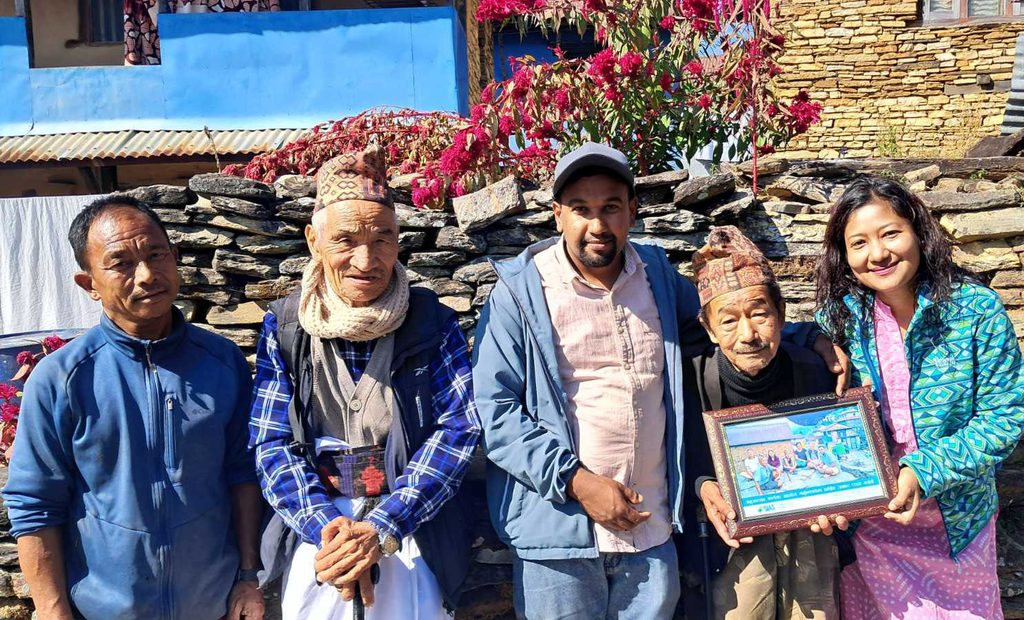
Handing over a framed photograph of our time together to the bajes as a small token of love and remembrance.
Similarly, our relationships with the didis (sisters) in the village extended beyond individual visits. We were welcomed into their homes, shared meals, and maintained connections through social media and phone calls, even during COVID-19 lockdowns. These ongoing interactions kept us informed about village developments and evolved into meaningful, reciprocal relationships with research participants.
The role of care thus becomes particularly important in shaping meaningful research relationships. Our engagement beyond the purposes of our research formed the basis of trust and reciprocity. Given the proliferation of social science research in rural Nepal, it also marked us as distinctive as we were not only driven by our need for information, access, or assistance, but also by a more humanistic connection. While we could not offer material support in any significant way, such acts of everyday care such as spending time, listening attentively, remembering, and simply being present, seemed to matter and should not be underestimated in research practice. As reflected in care-based research accounts, for instance, in the article by British political ecologist Sam Staddon, continuing to remember and reconnect with participants beyond the formal fieldwork period demonstrates an ongoing relational commitment, where returning to communities becomes an expression of care rather than obligation.
Ultimately, coming back is not only about extending fieldwork, but about recognising that people are not merely subjects to be studied, but individuals whose lives we become entangled with over time. Such an engagement requires an ethics of care that goes beyond data collection, one that acknowledges relationships, emotions, and responsibilities that unfold through repeated encounters. Staddon’s later reflections show how returning with her children transformed relationships in the field work, deepening mutual recognition, and shifting interactions from professional to relational, reminding us that research relations can evolve into meaningful human connections over time. In this sense, our engagements became more relational than transactional, grounded in attentiveness, memory and sustained presence.
Conclusion
We have reflected on ethnographic and participatory approaches to researching rural livelihoods amid concerns of extractive research. It highlights how sustained, long-term engagement with the community fostered a more grounded understanding of people’s daily lives, mitigating some of the ethical dilemmas all researchers face. Prolonged engagement in the village through repeated visits, although of shorter stays, enabled meaningful ethnographic insights to emerge organically, often through informal conversations and moments of shared experience.
We reflected upon how even shorter stays can be made meaningful by engaging in everyday activities, informal conversations, and community rituals that enabled us to develop nuanced understandings of migration, immobility, and place attachment which would not have emerged through interviews alone. Repeated field visits helped us understand how migrants maintained their connections to the place amidst widespread outmigration, and when people came back, it helped those staying to invoke vibrant memories. Field visits at different times of the year helped show the village as both empty and vibrant, and to interpret the migration dynamics in different contexts. Moreover, the positionality of some of us as Nepalis grounded in and familiar with local sociocultural and rural realities further strengthened this engagement. Being contextually attuned therefore allowed us to interpret nuances, practices, and narratives with greater sensitivity.
Small acts of caring and reciprocity, including emotional presence, shared labour, photographs, and participation in everyday and ceremonial life, helped foster trust and build relationships. Our contribution through engagement with the communities might seem ‘minimal’ to them, but their warmth and openness in allowing us to engage in their daily activities and celebrations made us believe we were giving something back. Overall, our experience emphasises that engaging in research through participatory approaches not only deepens understanding of rural lives but also creates opportunities for ethical engagement and care that can help refrain from extractive practices.
However, giving back might not be as straightforward and differs across contexts. In some settings, researchers may align with a local activist group or contribute financially or politically to ongoing struggles. Such pathways are more complex in Nepal. Deeply embedded social hierarchies often shape resource access and support, raising concerns that any material contribution might unintentionally reinforce existing inequalities. As researchers, we do not have the power to change these structural dynamics that have largely remained resilient through time.
Yet, this does not mean that our engagement is without value. Acts of respect, care, and sustained presence matter. While they may not resolve broader inequalities, they shape the ethics of how we conduct research and relate to people. Recognising this, we suggest that even within the constraints of short-term research, it is possible to move away from extractive practice by approaching research as a relational process grounded in care, attentiveness, and responsibility. Ultimately, avoiding ‘research tourism’ is not simply about the duration of the fieldwork, but about how we choose to engage.
The article is based on researchers’ fieldwork experiences, drawing primarily from the project, CLIMIG – A new interdisciplinary framework for studying the relation between climate change and migration project, at The Southasia Institute of Advanced Studies (SIAS), Kathmandu.
“Views expressed here are personal and not associated with any affiliated organisations”
This article was first published at the commons in October 26, 2026.