
– Trace Mdamu (Tanzania), Sharon Wambete (Kenya), Sanjeev Paneru (Nepal), Camil Guo (China), Sitong Shen (China), Panayiotis Louca (Cyprus), Esther Githinji (Kenya)– University of Edinburgh
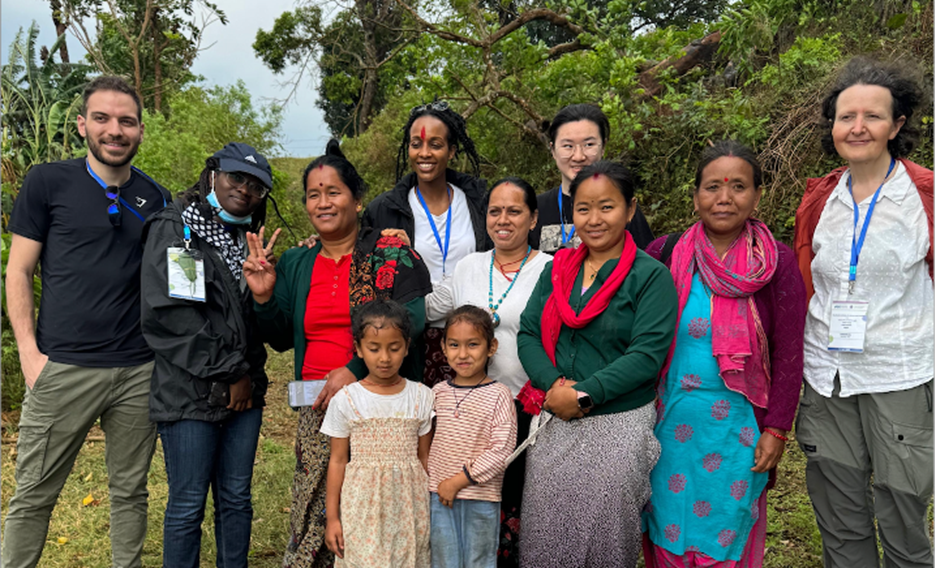
Caption (L-R) Panayiotis, Trace, Sharon, Camil, Aletta with Chhapelli Community
INTRODUCTION:
In our Nepal field trip, working collaboratively as a group on human-wildlife relations was a transformative learning experience. As part of the teaching methods, in one of our supervised group sessions following data collection, we were asked to share a one-word reflection on the experience we had with the Chhapeli Community Forest User Group. Some of the words we shared were; learning, gratefulness, kindness, wholesome, growing and mesmerised. From a multicultural group perspective, emotions played a part in how we engaged with the “other”. Some reflections from our group members follow:
Trace Mdamu (Tanzania)
CHALLENGING ASSUMPTIONS:
To be honest, I went into the Chhapeli focus group discussion expecting to hear strong concerns or tensions in relation to the wildlife. Instead, I was surprised by the CFUG members’ deep desire for coexistence with the wildlife, despite the losses they experienced. It was an almost reverent acknowledgement that ‘they were here before us’. This reflected a worldview so different from the hegemonic conservation discourses that often position local communities as obstacles to wildlife protection. I was challenged, even more, to first interrogate the assumptions I carried into the field, and to centre community knowledge more intentionally.
During an earlier session on Gender and Social Inclusion in Natural Resource Management, the presenter, Dibya Gurung, shared a quote that landed with weight. She said:
“A woman leader is like a tall bamboo: the taller it grows, the more it bends with the wind – bends but never breaks.”
This poetic quote captured the essence of the outlook I witnessed, not just in the women, but in Nepali people more broadly. Flexible yet rooted. That day in Chhapeli, I came to understand that this was not just resilience born of necessity, but of hope in their land and in each other.
Sharon Wambete (Kenya)
CONNECTION:
I joined the Student Exchange Program for the last 3 days of the field visit from Pokhara to Bandipur. The program was organized by Southasia Institute of Advanced Studies in collaboration with the University of Edinburgh. Even though my stay was short, it was a very memorable experience working with international students and learning together in the field.
At Bandipur,I was in the Wildlife themed group along with international friends—Camil, Panayiotis, Trace, Sharon, Sitong, Esther and Sam, our supervisor. We were accommodated at Cozy Mountain Hotel, and after freshening up, we conducted a team meeting. We were all worried about making people talk to the villagers, but I assured them that I would be starting the conversation with an icebreaker. The villagers were very welcoming and keen to speak with us. We respected their privacy. I appreciated a lot how Panayiotis was trying Nepali and mixing with locals. Sharon danced with kids, Camil documented all the moments, Sitong listened attentively, and Esther asked deep questions on compensation issues. All of them brought a special spark to this project.
These three days gave me something beyond books. I felt proud to represent my community and connect with people from different cultures. The conversations, the laughter, and the learning we shared will always stay close to my heart. It was not just an academic experience, it was human, emotional, and unforgettable.
Sanjeev Paneru (Nepal)
ETHICS:
Before heading into the field, I thought things would be straightforward—clear data, obvious issues, and neat solutions. But when we visited Bandipur and spoke with the Chhapeli CFUG, I quickly realized reality is a lot messier. I was genuinely touched by how the community talked about living alongside wildlife, which really challenged the assumptions I had from class readings. While taking photos and documenting their stories, I constantly worried if I was crossing any ethical lines—was I capturing their voices or just using them? This internal debate taught me that I wasn’t just there as an outsider looking in; my presence itself mattered and changed the interaction. Accepting this pushed me to be more empathetic, humble, and careful about how I do research. It made me rethink what ethical fieldwork truly means.
Camil Guo (China)
POSITIONALITY:
Before our trip, we had read some theoretical articles to remind us of reflecting critically and listening to the local voices humbly. Although I knew in theory that I had to get rid of the established perspective, it was extremely difficult to put it into practice. However, this field trip gave me the answer. What we need to do is not to pretend to be neutral, but to be honest about our position, to acknowledge subjectivity, and then build bridges of understanding with empathy and respect. Meanwhile, the observations we each make and the meanings we understand do not have to be the ultimate answers and solutions, but they constitute the fragments, paths and possibilities leading to understanding.
I began to accept that my understanding, even though it might be limited and subjective, still has its own value. This reminds me that not every researcher has to be an answerer, but sometimes, we should be the listeners. Just as we said in the presentation, although we cannot offer a solution, the true answers to environmental and development issues actually already lie in the wisdom of the local people.
Sitong Shen (China)
GROWTH:
This trip has been a transformative experience. I’ve created lasting memories and developed new ideas that have changed how I think. It made me realize how important it is to ask what the people directly affected by issues want, rather than assuming what’s best for them. It also reminded me of the responsibility that comes with privilege. Use it to support and amplify the voices of others, not to speak over them.
I came into this course hoping to find answers, using theories and frameworks to make sense of complex issues. But instead of clarity, I found depth. I learned that knowledge is not a fixed point, but a weaving of stories, perceptions and lived experiences. I began to unlearn the comforts of objectivity and saw how meaning is made in the space between “me” and “them”. It became clear that understanding is not about finding definitive truths, but about engaging with the complexity and diversity of human experience.
Panayiotis Louca (Cyprus)
LESSONS:
Finally, when I thought about how I would come away from this field trip, I envisioned gaining qualitative research skills and proving that I can be an ethical researcher. However, the reality is that it was far beyond the narrow academic focus I had imagined. I have come away with life lessons. Many argue that in the development sector you can never separate yourself from the work. I always wondered how practical that was, but this experience has unveiled that sometimes it is important for your emotions to get in the way of your work to reveal the world as it is. Most transformational of all, I have learned what it means to be an ethical environment and development practitioner from the Chhapeli community. That I should not see things in the singular as ‘good’ or ‘bad’, rather by acknowledging that life is relational, I should seek to explore relationships. That way, solutions can never be linear but circular and can never be achieved alone but together.
Esther Githinji (Kenya)
“Views expressed here are personal and not associated with any affiliated organisations”