
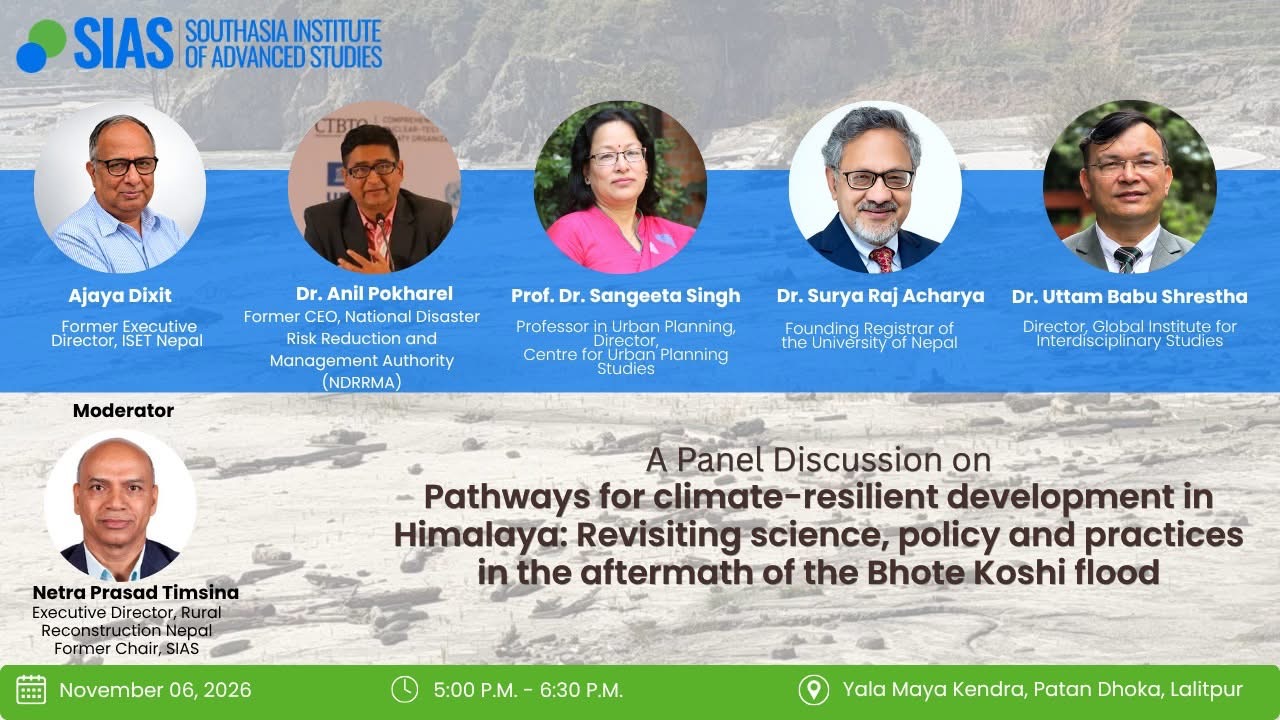
On the occasion of 17th AGM, SIAS hosted a panel discussion on “Pathways for climate-resilient development in the Himalaya: Revisiting science, policy and practices in the aftermath of the Bhote Koshi flood.”
It was chaired by Krishna Gyawali, SIAS board chair and moderated by Dr. Netra Timsina, the executive director of Rural Reconstruction Nepal. The panel brought together experts in urban planning, infrastructure, science, river basin development and disaster governance: Ajaya Dixit, Dr. Anil Pokharel, Prof. Dr. Sangeeta Singh, Dr. Surya Raj Acharya and Dr. Uttam Babu Shrestha.
The discussion reflected on the devastating Bhote Koshi flood of 26 August 2026 and examined the broader challenges of disaster preparedness and climate-resilient development in Nepal.
A central theme emerging from the discussion was that the disaster was not simply the result of an extreme natural event, but also reflected long-standing gaps in planning, governance and risk management. Panelists highlighted how decades of infrastructure development, settlement expansion, hydropower construction and rebuilding in vulnerable river corridors have increased exposure to disaster risks. They emphasised the need to recognise how development decisions can create and intensify vulnerabilities.
Key Discussions:
- Strengthening science and research: Nepal needs stronger investment in disaster-related research, systematic monitoring, hazard mapping and modelling. Scientific knowledge must be effectively communicated and translated into policies and practical action.
- Moving beyond early warnings: Early warning systems must go beyond forecasts and alerts. They should be supported by evacuation plans, designated safe locations, effective communication and the capacity of local authorities and communities to respond.
- Promoting risk-sensitive infrastructure: Roads, bridges, hydropower projects and other infrastructure must be planned with proper consideration of geological conditions, river dynamics and future climate risks. Planning fundamentals, technical standards and institutional accountability need greater attention.
- Ensuring people-centred resettlement: Relocation from high-risk areas must consider community participation, secure land, livelihoods, mobility, connectivity and social and cultural ties. Rebuilding should prioritise safety and long-term sustainability rather than simply restoring previous settlements.
- Strengthening institutional coordination and accountability: Disaster risk reduction and climate change adaptation need to be addressed through coordinated institutional frameworks. Existing policies and research must inform implementation, while public institutions and development actors must be held accountable for decisions that shape disaster risks.
The panel also highlighted the importance of learning from previous disasters rather than repeatedly responding to crises without addressing their underlying causes. Participants stressed that research should be transformative, policies should respond to people’s needs, and development interventions must account for the interconnected nature of environmental, social and economic vulnerabilities.
The discussion concluded with a call to move from recognising collective failure towards establishing collective accountability. Building climate-resilient communities in the Himalaya requires stronger collaboration among researchers, policymakers, practitioners, institutions and local communities, ensuring that scientific evidence informs development decisions and disaster risk governance.