
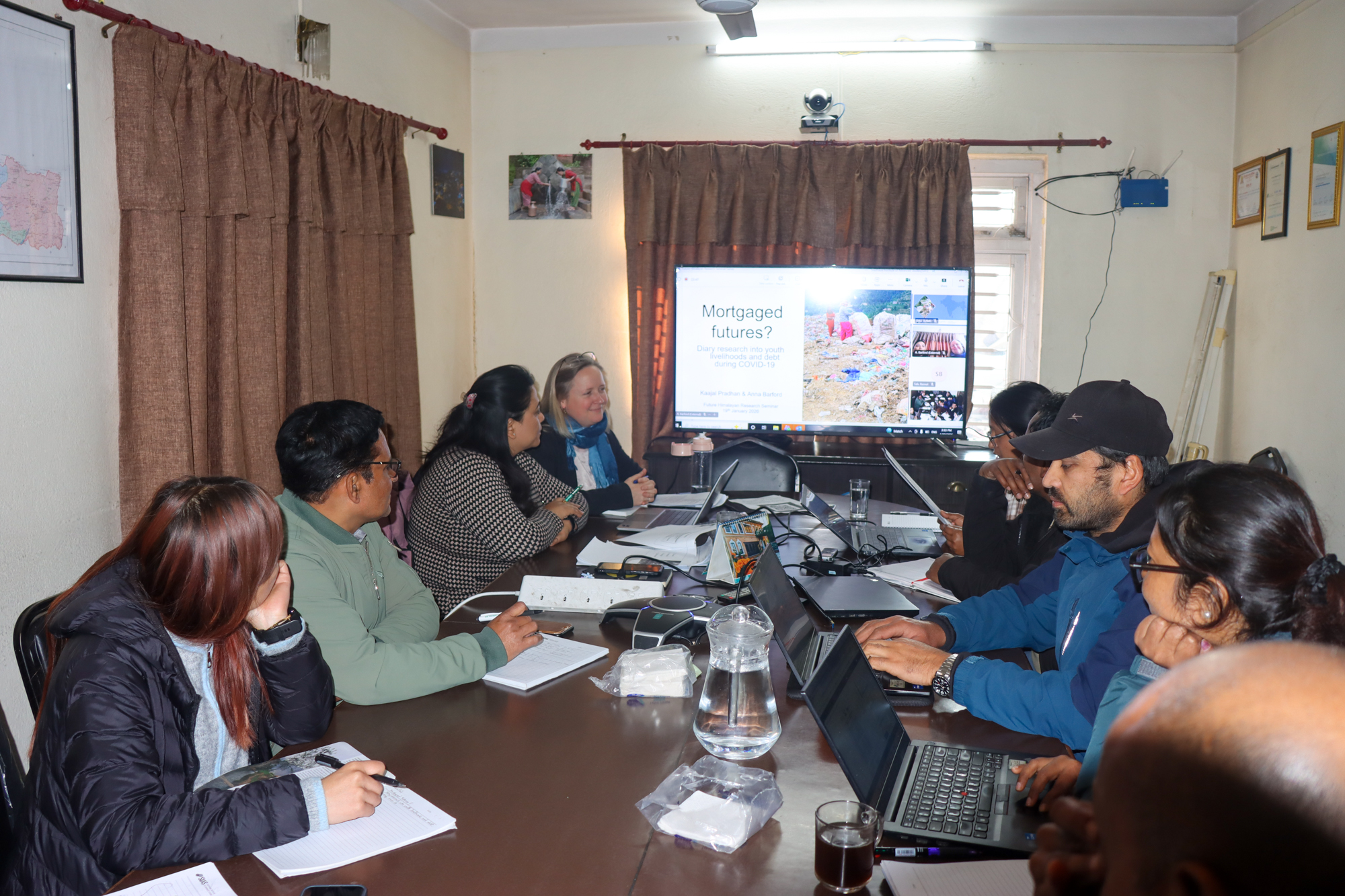
On 19 January 2026, SIAS hosted the Future Himalayan Research Seminar titled “Mortgaged Futures? Diary Research into Youth Livelihoods and Debt during COVID-19”, presented by Professor Anna Barford from the University of Cambridge and Kaajal Pradhan, Country Manager at Kindernothilfe (KNH) Nepal. The seminar explored how the COVID-19 pandemic reshaped youth livelihoods in Nepal, intensified financial insecurity, and drove many young people into debt, with long-term implications for their futures.
The study, conducted during Nepal’s second COVID-19 lockdown (March–July 2021), highlighted that young people were disproportionately affected by the crisis. Youth employment, generally more vulnerable to economic shocks, faced disruptions due to school closures, interrupted school-to-work transitions, and the “last-in, first-out” nature of employment. Policy attention to youth employment remained limited, as governments focused on immediate health and economic stabilization measures.
Funded by the Asian Development Bank (ADB) and led by Restless Development Nepal in collaboration with the University of Cambridge and partners in Indonesia, the research focused on Nepal, aiming to examine the impacts of COVID-19 on youth livelihoods, income stability, debt accumulation, and coping strategies, while also testing the feasibility of youth-led diary research during a crisis.
A central feature of the methodology was the use of weekly diaries over four months, which allowed remote, longitudinal tracking of experiences, emotions, and decision-making. Fifty young participants contributed over 1,400 diary entries, drawn from five particularly vulnerable groups: young mothers engaged in care work, tourism and trekking workers, healthcare workers, migrant waste pickers, and LGBTQI+ youth. Each cluster was supported by a rapporteur, someone with similar lived experience to assist with recruitment, guidance, and safeguarding.
The research followed a youth-led, co-research approach promoted by Restless Development. Young people were actively involved in designing research tools, collecting data, translating and transcribing diaries, coding and analyzing findings, validating results, and disseminating evidence. Their perspectives were embedded as essential expertise, ensuring the study reflected youth realities rather than external interpretations.
Findings revealed that COVID-19 caused deep, uneven, and intersecting impacts on young people’s lives. Many participants lost jobs, experienced reduced working hours, or moved into precarious employment. Income instability was exacerbated by rising costs and mobility restrictions, while disruptions to education and skill development affected young people at critical life transitions.
Debt emerged as a major coping strategy. Young people frequently borrowed from informal sources to meet basic needs such as food, rent, cooking fuel, and healthcare. These short-term survival debts, rather than investments, risked long-term scarring, effectively “mortgaging futures.” Mental health stress and emotional strain were significant, particularly among young mothers and LGBTQI+ youth, reflecting compounded vulnerabilities from economic and social marginalization. Social protection systems were often inadequate or inaccessible, leaving young people reliant on family, community networks, or risky coping strategies.
The discussion following the presentation focused on methodological insights and challenges of diary-based research during crises. Participants highlighted that diaries offer richer, evolving, and personal accounts compared with conventional surveys and interviews. Questions were raised about sustaining participation, literacy and writing capacity, data reliability, and ethical responsibilities. Presenters emphasized the critical role of rapporteurs, flexible timelines, training, translation support, and modest compensation in maintaining engagement and ensuring accurate, inclusive data. Safeguarding protocols addressed sensitive disclosures, illness, bereavement, and emotional distress, while triangulation through focus groups and follow-up calls enhanced data credibility.
Participants also reflected practical applications of diary methods beyond the pandemic, noting their value for long-term monitoring, program design, and understanding marginalized experiences. Despite being resource-intensive, diary research was recognized for capturing nuanced, longitudinal insights that conventional methods often miss.
In conclusion, the seminar underscored the power of youth-led diary research to document lived experiences during crises. The approach strengthens both research quality and policy relevance, highlighting the importance of youth-centered recovery policies, inclusive social protection systems, and recognition of informal and care-based livelihoods. Engaging young people as co-researchers ensures that interventions and policies are informed by the realities of those most affected.