
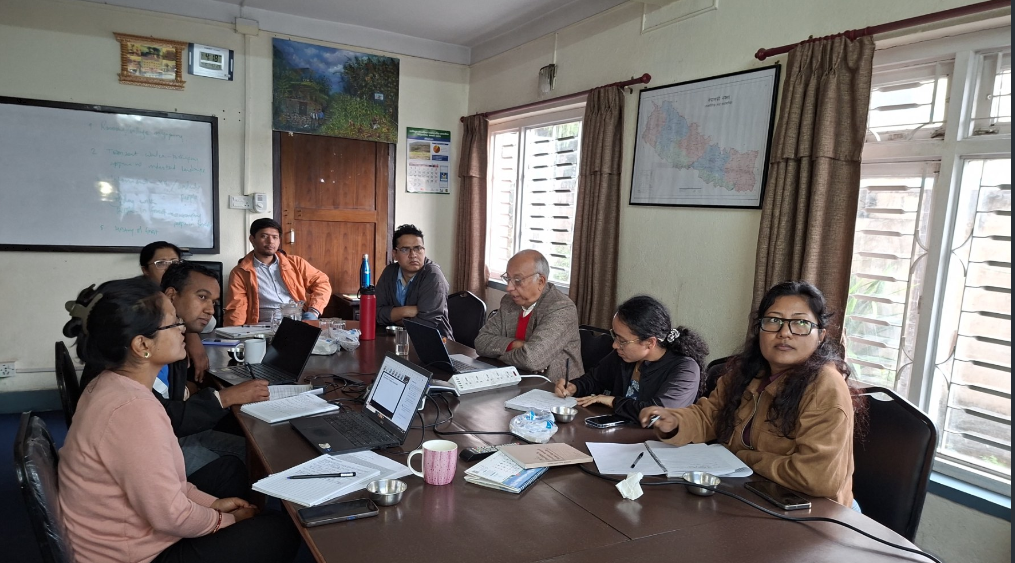
SIAS successfully hosted an engaging and insightful session under The Future Himalayan Research Seminar Series on 30 April 2026 at the SIAS Meeting Hall. The seminar featured Dr. Umesh Nath Parajuli, an interdisciplinary water management engineer, who delivered a thought-provoking presentation on “Indigenous Water Management Technologies and Practices: Understanding their Scientific Basis for Contemporary Innovation in Managing Water.” The session began with a warm welcome and introduction of the speaker by Dr. Anushiya Shrestha, setting a welcoming tone for the discussion.
Setting a strong conceptual foundation for the seminar, Dr. Parajuli opened his presentation by distinguishing between indigenous and traditional knowledge systems. He explained that indigenous practices are inherently local or native, continuously evolving, and often shaped by a strong intent for improvement and adaptation. In contrast, traditional practices are defined by their age and continuity over time and may not necessarily be local in origin. This distinction helped frame the discussion by clarifying how knowledge systems evolve and how innovation can emerge from both continuity and adaptation. In his presentation, Dr. Parajuli highlighted the growing importance of indigenous and traditional knowledge systems in addressing contemporary challenges related to water management, climate change, and sustainable development. Drawing from examples across Central and South Asia, he demonstrated how these practices, deeply rooted in ecological, social, and geo-hydrological principles, provide practical, cost-effective, and climate-resilient solutions. He emphasized that indigenous technologies are not only scientifically grounded but also inherently adaptive, decentralized, and designed for long-term sustainability, often requiring low operation and maintenance while ensuring equitable water distribution.
The seminar further explored the integration of nature-based solutions and locally led adaptation approaches, along with community-driven institutional models for water governance. Through a series of case studies, Dr. Parajuli illustrated how traditional practices such as riverine forest-based flood management, federated water user associations, innovative weir systems, and the revival of Karez-like technologies can effectively address water scarcity, reduce environmental degradation, and enhance resilience to climate variability. He also raised critical reflections on the need to incorporate these indigenous concepts into modern policy frameworks, academic curricula, and engineering practices.
The session concluded with a lively and interactive discussion, where participants from both physical and virtual platforms actively engaged with the speaker. The exchange of ideas, questions, and reflections highlighted the relevance of combining traditional knowledge with contemporary scientific approaches to foster sustainable and inclusive water management systems. Overall, the seminar was highly enriching and underscored the importance of continued dialogue, research, and collaboration in advancing climate-resilient development in the Himalayan region.