
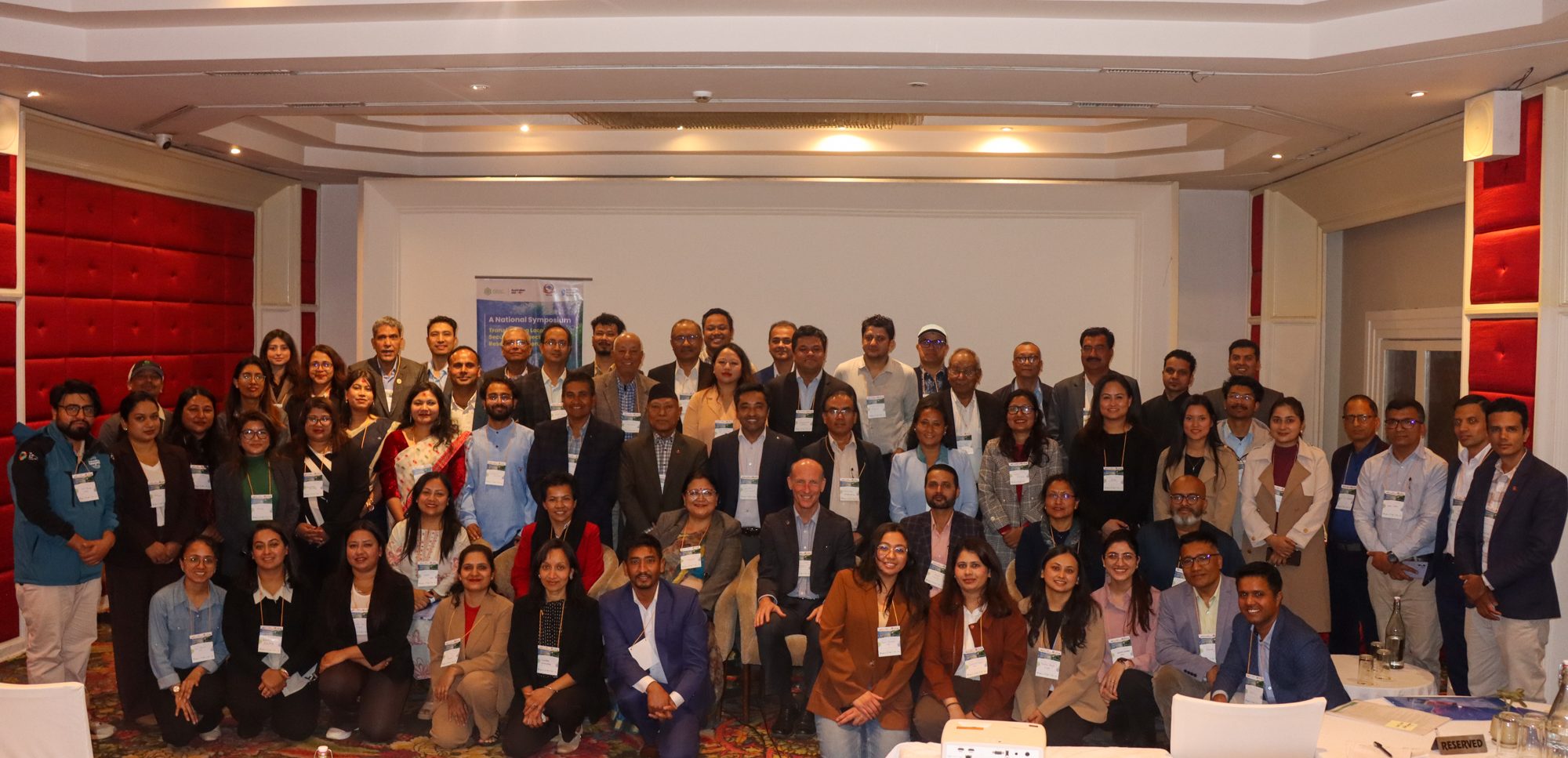
The National Symposium on “Transforming Local Water Security: Connecting Research, Action, and Policy”, organized as part of the Nepal National Glacier, Water and Weather Week (NNGWWW) 2026, was held on 20 March. The event was co-organized by the Southasia Institute of Advanced Studies (SIAS), Nepal Development Research Institute (NDRI), The Small Earth Nepal (SEN), International Water Management Institute (IWMI), Nepal Water Conservation Foundation (NWCF), and the Australian National University (ANU), in collaboration with the Water and Energy Commission Secretariat (WECS). The symposium was supported by the Australian Centre for International Agricultural Research (ACIAR) and the Commonwealth Scientific and Industrial Research Organisation (CSIRO) through the Muhan Project.
The opening session was chaired by Mr. Tika Ram Baral, Joint Secretary of WECS. The keynote address was delivered by Dr. Mandira Singh Shrestha, Board Director of Water Centre 21 Pahal and a leading expert in disaster risk reduction, climate services, and water resources management. She highlighted the growing threat of drying springs, which remain a critical water source for millions of people across the region, and emphasized the need for integrated, gender-responsive, and science-based approaches to strengthen water security and resilience.
The symposium also featured remarks from H.E. Simon Ernst, Ambassador of Australia to Nepal, who highlighted the increasing water stress faced by both Australia and Nepal due to climate variability and extreme weather events. He stressed the importance of strengthening institutional collaboration, evidence-based policymaking, and long-term governance systems to build climate resilience. In his closing remarks, Mr. Tika Ram Baral underscored the urgency of addressing emerging water security challenges and emphasized the importance of stronger partnerships among researchers, policymakers, and practitioners to develop effective and sustainable solutions.
The symposium featured three thematic sessions exploring different dimensions of local water security and hydro-social governance. The first session, “Understanding Local Hydro-sociology and Restoring Local Water Sources,” was chaired by Dr. Shankar Shrestha and moderated by Ms. Shreya Bajimaya. Presentations in this session focused on water source restoration and community-based water management practices. The second session, “Inclusive Local Water Governance and Equitable Water Access,” was chaired by Dr. Dil Khatri and moderated by Dr. Gyanu Maskey, and explored issues of equity, governance, and social inclusion in water management. The third session, “Analytical Tools, Frameworks, and Approaches for Hydro-social Water Governance,” was chaired by Dr. Madan Lal Shrestha and moderated by Ms. Suchita Shrestha. This session examined innovative methods and analytical frameworks for understanding hydro-social dynamics and supporting evidence-informed decision-making.
Dedicated poster sessions provided a platform for emerging researchers and young professionals to showcase innovative ideas and ongoing studies related to local water security.
The symposium concluded with a high-level panel discussion titled “Bridging Research, Policy, and Practice for Water Security,” moderated by Dr. Divas Bahadur Basnyat, Lead/Coordinator of the Water and Climate Program at NDRI. The panel featured distinguished experts including Dr. Bishnu Hari Poudyal, Country Expert/Liaison Officer for the Green Climate Fund (GCF) in Nepal; Dr. Narendra Raj Khanal, former Professor and Head of the Central Department of Geography at Tribhuvan University; Ms. Shanti Kandel, Senior Divisional Meteorologist and Office Chief at the Office of Hydrology and Meteorology, Pokhara; Dr. Manju Sharma, Senior Sociologist and Institutional, Social, and GESI Expert at the Department of Water Resources and Irrigation; and Prof. Dr. Vishnu Prasad Pandey, Executive Director of the Center for International Relations and Professor at the Institute of Engineering, Tribhuvan University.
The panel discussion highlighted growing pressures on Nepal’s water resources resulting from climate change, environmental degradation, rapid urbanization, and unsustainable resource use. Panelists emphasized the importance of integrated water governance approaches that connect scientific research, policy processes, and practical action while ensuring the inclusion of local communities, women, and marginalized groups. The symposium concluded with a collective call for stronger collaboration among researchers, policymakers, development partners, and local stakeholders to advance sustainable and climate-resilient water governance.