
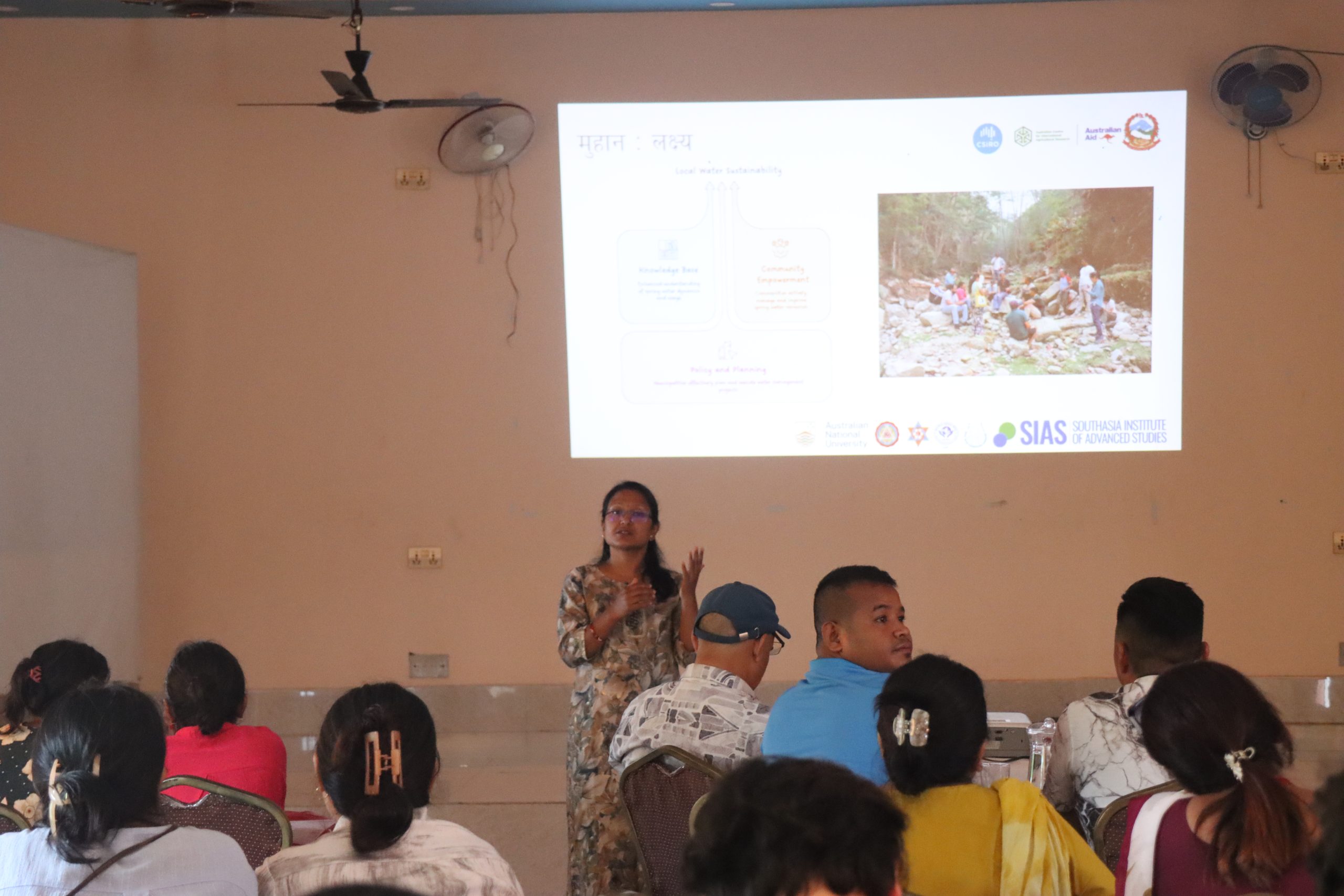
On 23 September 2026, the Muhan Project team and Kamalamai Municipality co-organised a knowledge exchange workshop that brought together stakeholders involved in spring water management in Kamalamai Municipality, Sindhuli. The participants included the mayor and other local government representatives, community leaders, water user groups, farmers, hotel entrepreneurs, and representatives of other projects working on springwater management in Kamalamai Municipality. The workshop involved sharing emerging research findings from the Muhan Project, reflections from the stakeholders, and collaboratively identifying pathways for inclusive and sustainable springwater management.
SIAS, Nepal Development Research Institute (NDRI), and Nepal Water Conservation Foundation (NWCF), the Muhan research partners in Nepal, presented the biophysical, socio-economic, and governance dimensions of springwater management, along with potential technical solutions identified through research and community consultations, including recharge ponds, vegetative check dams, and household-level water retention measures.
Participants noted that Kamalamai is a rapidly growing municipality with an increasing population and rising water demand. Stakeholders of Gwang Khola emphasised declining water flow in Gwang Khola and a considerable increase in its users and uses have added pressure on Gwang Khola, a key water source for upstream farmers, the growing Chiyabari market, and the Siddheshwor Drinking Water and Sanitation User Committee. Participants also raised concerns about deteriorating water quality and limited coordination between upstream and downstream communities.
These challenges have increased local recognition of the need for integrated springshed protection and recharge measures to strengthen long-term water security. In his remarks, the mayor highlighted the importance of investing in water recharge and source protection measures alongside water-supply infrastructure construction. The municipal focal person for the Muhan Project further noted that, despite several water-related projects operating in the area, weak coordination with the local government and limited technical and financial capacity at the local level have resulted in fragmented interventions and outcomes. The participants also agreed on the need to improve institutional coordination and coordination between water users in the Gwang catchment, raise awareness for sustainable water use and conservation of local springwater sources and foster inclusive and sustainable springwater management in Kamalamai Municipality.
The ward chair of ward 2 noted that water availability has declined due to extensive extraction through multiple supply pipes at different locations and also raised concerns about declining water availability for irrigation. He emphasised the need for improved management of both drinking and irrigation water, including the construction of recharge ponds along the Gwang Khola corridor. He further proposed that the Palika formalise the task force by developing appropriate working procedures to guide its functioning. He also expressed his commitment that the ward will support the taskforce, facilitate the formulation of water management related policies of Palika and utilise the research findings of the Muhan project for planning and budget allocation for water management programs at the ward level.
A key outcome of the workshop was the formation of a seven-member task force, comprising two representatives from upstream communities, two from Chiyabari, two from the Siddheshwor Drinking Water and Sanitation User Committee, and one representative appointed by the local government. The task force will facilitate communication and coordination between upstream and downstream communities to protect spring sources and the entire watershed and bring community concerns and research findings into policy dialogue. It will also raise awareness of sustainable water use and the conservation of local springs, assist in implementing socio-technical solutions identified through Muhan research and documenting the key issues, insights, and potential policy-oriented solutions. The Task Force will support the municipality in developing water and watershed-related policies leading a long-term water management and allocation plan for sustainable use and equitable distribution of water and work together with municipality work towards its formal recognition from the municipality.
This initiative reflects an important step towards community-led, evidence-based collaborative water governance, where local knowledge, interdisciplinary research insights, and locally led planning come together to ensure the sustainable management of springs and watersheds.