
-Meadow Solares | Environment and Development M.Sc., University of Edinburgh.
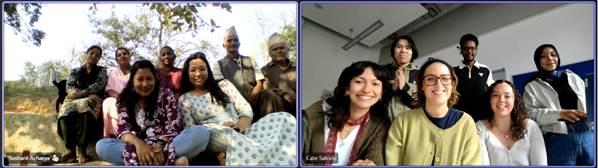
Due to travel restrictions emerging from the war in West Asia, the Southasia Institute of Advanced Studies–University of Edinburgh (SIAS-UoE) 2026 Nepal trip was cancelled. Although I was initially disappointed that I could not physically travel to Nepal for our fieldwork with SIAS, I am deeply grateful for everything that I experienced instead. The collaborative efforts of our course organizers, Sam Staddon and Clare Barnes, coordinator Sanjaya Khatri, and many others, allowed our cohort to engage in virtual fieldwork in Bandipur, Nepal, whilst staying in Scotland. Through this experience, my perspectives of the world (and on my own positionality) have transformed.
Conducting virtual fieldwork with SIAS in Nepal prompted critical reflection on my own positionality as a researcher. My academic training, rooted primarily in Western institutions, has shaped how I interpret environmental issues, often through theoretical frameworks rather than lived experience. At the same time, my personal background as the daughter of a Central American immigrant in the United States has influenced my sense of belonging and cultural navigation. I have often felt uncertain about entering unfamiliar spaces, concerned about being intrusive or out of place.
However, engaging with our participants in Bandipur began to shift this perspective. Rather than viewing myself as an outsider entering a fixed space, I came to understand engagement as a relational process grounded in humility, reciprocity, and reflexivity. This aligns with broader calls in development research to critically examine the positionality of researchers and the power dynamics embedded in knowledge production (Strumm, 2020). Although virtual engagement limited certain aspects of connection, I was surprised by how much energy, emotion, and mutual curiosity could still be felt through the virtual data collection process. At the same time, I remain aware of the partial nature of my understanding and how distance shapes interpretation.
Within our project groups, I chose to work on climate migration, a topic that initially appeared distinct but quickly revealed itself to be deeply interconnected with broader environmental and social challenges. SIAS presentations and secondary data demonstrated that migration in Nepal is shaped by a convergence of factors, including agricultural conditions, infrastructure, and livelihood opportunities.
This complexity aligns with critiques of linear “push–pull” migration models, which fail to capture the structural and environmental conditions shaping mobility. Rather than being driven by a single cause, migration reflects layered realities and adaptive strategies (Black et al., 2011).
A particularly striking theme was the gendered dimension of these realities. In many communities, men migrate for work, leaving women, children, and the elderly to manage households and agricultural responsibilities under increasingly uncertain conditions. This redistribution of labour reflects insights from feminist political ecology, which highlights how environmental change intersects with gendered power relations (Rocheleau et al., 1996).
Beyond all of the learning that took place through virtual fieldwork, our course also engaged with Nepali culture through visits to cornerstones of Nepal that exist here in Edinburgh. At the Himalayan Center for Arts and Culture, we attended the community New Year’s Eve celebration, where we learned traditional dances and shared conversations over delicious, homemade food.
At the Edinburgh Royal Botanic Garden, we had the chance to explore the section dedicated to representing features of Nepal’s landscape. Walking through the gardens reminded me how we all have connections to the natural world often extend beyond what words alone can describe. These encounters challenged my assumption that “the field” must be geographically distant, instead suggesting that it can be constructed through intentional and situated forms of engagement. Most importantly, to cultivate relationships with people and places, there is a need for reciprocity.
Studying environment and development ‘in the field’, I have come to realize, is not defined solely by physical presence. It is shaped by the quality of engagement, the willingness to reflect critically, and the ability to navigate relationships across differences. While I still wonder how fieldwork might have differed in Nepal, I feel very lucky to have been a part of this experience and recognize that the redirections we faced also created new opportunities for insight.
“Views expressed here are personal and not associated with any affiliated organisations”