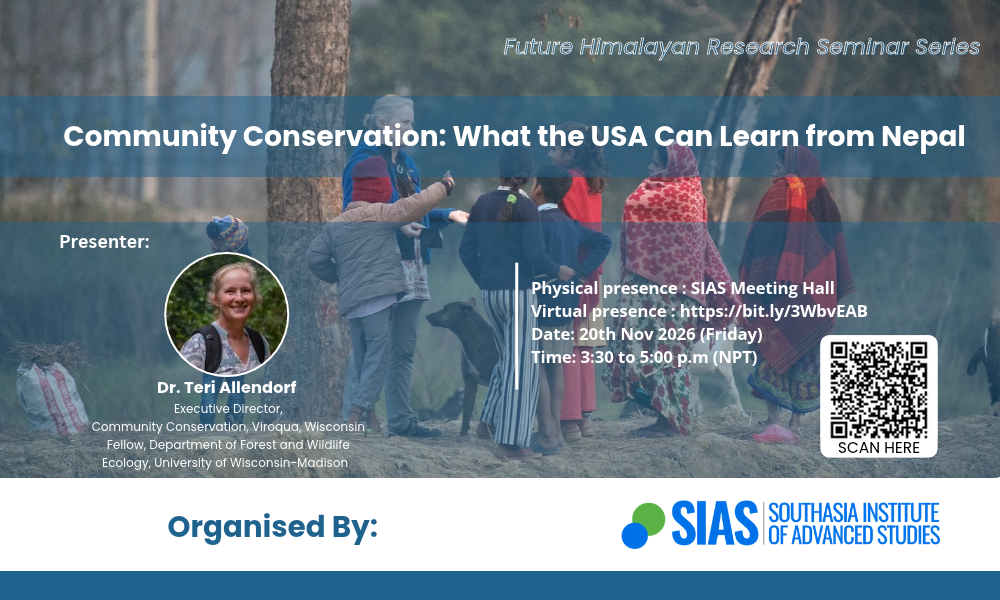
The Southasia Institute of Advanced Studies (SIAS) is organising the upcoming Future Himalayan Research Seminar titled “Community Conservation: What the USA Can Learn from Nepal” on 20 November 2026. The seminar will feature Dr. Teri Allendorf, Executive Director of Community Conservation, Viroqua, Wisconsin, and Fellow at the Department of Forest and Wildlife Ecology, University of Wisconsin-Madison.
The seminar will explore the role of local communities in biodiversity conservation, drawing on experiences from Nepal and Namibia to examine how community-led approaches can inform conservation practices in the United States. It will also consider how experiences and lessons from different geographical contexts can contribute to strengthening community engagement and achieving long-term biodiversity conservation outcomes.
Research Overview
Biodiversity is declining at an alarming rate, yet evidence from different parts of the world suggests that conservation efforts are most effective when local communities play a central role in protecting and managing natural resources. Nepal’s community forestry programme and Namibia’s communal conservancies offer important examples of how community-led approaches can contribute to forest conservation and wildlife recovery. However, such approaches have not been widely adopted in the United States, where conservation initiatives are more commonly described as collaborative, cooperative, or collective conservation. The seminar will explore whether these approaches share the defining features of community conservation, particularly local authority over resource management and the legal recognition of community institutions. Drawing on experiences from Nepal, Namibia, and the United States, the discussion will examine opportunities for cross-country learning and how stronger community engagement can contribute to more effective and sustainable biodiversity conservation outcomes.
Key Discussion Themes
The seminar will have several interconnected themes:
- Community-led Conservation: Examining how local communities can become primary agents in biodiversity protection and natural resource management, drawing on experiences from Nepal and Namibia.
- Legal Recognition and Local Authority: Exploring the importance of legally recognised community institutions and local decision-making authority in achieving effective conservation outcomes.
- Conservation Approaches in the United States: Examining whether collaborative, cooperative, and collective conservation initiatives in the United States reflect the principles of community conservation.
- Cross-country Learning and Knowledge Exchange: Understanding how conservation experiences from Nepal and Namibia can inform practices in the United States, and what US experiences can offer in return.
- Strengthening Long-term Biodiversity Outcomes: Exploring how meaningful community engagement can contribute to more effective, inclusive, and sustainable conservation efforts across different geographical and institutional contexts.
Conclusion
The seminar will provide an opportunity for researchers, practitioners, and participants to engage in meaningful discussions on community-led conservation and its potential across different contexts. By bringing experiences from Nepal, Namibia, and the United States into dialogue, the seminar seeks to foster cross-country learning and contribute to broader conversations on strengthening community participation in biodiversity conservation.